Thursday, November 29, 2012

The Richest Woman in America


The Richest Woman in America: Hetty Green in the Gilded Age
by Janet Wallach Upper Level New Book - BIO Green

Hetty Green should be at the top of the list of feminist icons. From the 1870's until her death in 1916, she exemplified the feminist ideal in many ways; she ran her own business, lived her life her by her own rules, and went down to Wall Street every morning and beat the men at their own game on their own turf. Her business acumen earned the respect of contemporaries such as J.P. Morgan, John D. Rockefeller, and Andrew Carnegie. She saved New York City from bankrupcy several times by loaning it money at below-market rates. And yet if she is remembered today at all, it is as "the witch of Wall Street", one of history's biggest misers.

In "The Richest Woman in America" Janet Wallach traces Hetty Green's life back to her Quaker upbringing that put her forever at odds with the media's idea of how women of her class should behave. They couldn't comprehend her plain personal tastes in someone with so much money. She simply didn't care about stylish gowns, opulent mansions, and lavish parties. And they mocked her relentlessly for it, ignoring the millions she spent building libraries and hospitals, endowing colleges, and helping those who genuinely needed it.

Hetty Green isn't remembered as one of the great american proto-feminists and iconoclasts because she never had time for the movement's marches and speeches and publicity stunts. She was too busy living the life that they wanted women to have the opportunity to lead. A fascinating life ably chronicled by Janet Wallach.


Wednesday, November 21, 2012

I Kissed the Baby

I Kissed the Baby by Mary Murphy.
Picture Books - Lower Level - MUR

Bold pictures, mostly white on a black background, with shots of bright yellow and pink, illustrate this story. Pond animals including fish, birds, a squirrel, and insects, all join to welcome a new baby. Each spread features two animals, the first asking the other a question about the baby: “I tickled the baby! Did you tickle the baby?” “Yes! I tickled the baby, the wriggly giggly thing!” Finally, at the end, we meet the adorable duckling that everyone is so excited about. Though it isn’t rhymed text, lots of attention is paid to the sound of the words for reading aloud. The short text and bold images make it perfect for reading to babies and toddlers, but it was still fun enough for my eight-year-old to want to read it to his sister, and she both asked for it and read it to herself over and over again. I often get asked about recommended books for new baby gifts, and this is a great one. It’s still in print in board book, which is ideal for the target age, and you can still find it in hardcover if you look.

Here are other board book favorites about baby love just right for new babies:
Everywhere Babies by Susan Meyers. Illustrated by Marla Frazee.
Picture Books - Lower Level - MEY

Hush, Little Baby by Marla Frazee.
Picture Books - Lower Level - FRA

Snuggle Puppy by Sandra Boynton.
Board Book Bins - Lower Level

All of Baby Nose to Toes by Victoria Adler. Illustrated by Hiroe Nakata.
Picture Books - Lower Level - ADL


Saturday, November 17, 2012

Son


Son by Lois Lowry
Teen Zone New Fiction – Main Level – LOWRY


In this sequel to The Giver, Lois Lowry pulls together characters from the previous three books in ‘The Giver Quartet’ in a satisfying conclusion. Following Claire, a teenage girl chosen to be a ‘birthmother’, Son tells the tale of what happens when this young girl is unable to come to terms with being separated from her baby. Risking everything to be reunited with her son, Claire finds herself in new, strange places that are nothing like the community in which she was raised.

Readers young and old who loved any or all books in ‘The Giver Quartet’ will enjoy this page-turner that brings them back to the dystopia first created in The Giver. In this long-awaited conclusion, Lowry takes readers on an emotional and nostalgic journey that brings many of the quartet’s loose ends together at last.


Friday, November 16, 2012

The Convicts


The Convicts by Iain Lawrence
Teen Zone Fiction-Main Level LAWRENCE


Tom Tin’s life is about to get horribly worse. A young teen in 19th century London, Tom has already experienced the death of his sister, the ensuing madness of his mother, and finally Tom has to watch his father being thrown in debtor’s prison. Tom’s fortunes briefly appear to be turning around when he finds a diamond on the shoreline. However, Tom’s diamond is lost during a botched grave robbing attempt while soon afterwards a case of mistaken identity and false accusations will put Tom in a prison ship for boys. Here, he will have to find the strength to simply survive let alone possibly escape.

The Convicts by Iain Lawrence is the first part of a trilogy concerning Tom Tin and his friends. The novel is an excellent book for readers who are looking for a story with adventure or one that has characters overcoming adversity and changing for the better. Tom does not start out as a particularly noble young boy. He is more than a little selfish, self-serving, and sometimes even cruel. By the end however, he starts to value and look out for his friends and family more than before his ordeal. An enjoyable historical fiction read for any age.


Tuesday, November 13, 2012

Between

Between by Jessica Warman
Teen Zone Fiction - Main Level - Warman


Liz Valchar dies on her 18th birthday, and then spends the next several months with another dead teenager. They visit old memories and watch their family and friends, trying to figure out what happened to them. Liz and her friends are all rich, privileged teens with secrets and problems they hide from each other - and even from themselves in some cases.

Themes and subjects include: death, teens, anorexia, wealth, drowning, drug use, ghosts, afterlife, murder, and unsolved crimes. In other words, it is filled with lots of angst, fear, and worry, but ultimately peace and redemption. This haunting novel is recommended to mature teens and adults.

Wednesday, October 31, 2012

The Iron Wyrm Affair

The Iron Wyrm Affair. Bannon and Clare Book 1. by Lilith Saintcrow.
Adult New Books – Main Level – SCI FI SAINTCROW

The Iron Wyrm Affair drops us into the middle of a fight scene in a complex alternate-Victorian steampunk world. I think it was the complexity of this world that made the first couple of chapters feel slow to me, even though it started off with action and never slowed down. Emma Bannon is a top-level sorceress, a Prima, in service to Queen Victrix, current vessel of the ancient spirit Britannia. Emma is talented, beautiful, fashionable, and fiercely intelligent and has fought her way up from the gutter to be the only Prima among several male Primes. (Though she’s fashionable because she wants to be, her jewelry stores power for her and is always chosen carefully as an ensemble.) As our story begins, she’s searching for Archibald Clare, an unlicensed mentath. Here we must learn that a mentath is someone along the order of Sherlock Holmes, more intelligent than your standard-issue genius, who notices details without trying, processing them into patterns, and who will go crazy without enough information to process. Clare, having lost his license, is indeed on the verge of insanity, but Bannon is looking for him because he is the last mentath of any kind to be found in London, the rest having been recently murdered. Bannon’s out to protect Clare, but as long as he’s in her house, he might as well be useful – and all the murdered mentaths are the first pieces of a dark puzzle that leads to a threat against Queen Victrix herself. (Here I confess that I was did double takes the whole book, trying to keep straight that Bannon meant Emma and Clare, Archibald – I kept want Clare to be the woman. Oy.) Bannon is assisted by a single Shield, Mikal, a man with yellow eyes and a dark past, whom Bannon both can’t completely trust and can’t stop being attracted to (but not in a romance-novel, can’t focus on anything else kind of way, and we never see inside his head). As mentaths and sorcerers don’t really work well in close proximity, Bannon hires Ventinelli, an assassin whom Clare rightly immediately pegs as an aristocrat hiding as gutter scum, to act as Clare’s bodyguard. Bannon and Clare set off in opposite directions, she investigating the magical murder of another sorcerer as she was trying to interrogate him, and he to find out the reason there are suddenly no Prussian capacitors on the market, a line of investigation which leads to large clockwork war spiders. The combination of magic and Holmesian mystery is intriguing, the setting brought beautifully to life, the characters interesting. It’s not as funny as Gail Carriger’s Soulless, and deals much more with the dark and seamy side of politics, though with somewhat fewer serious underlying issues thanThe Iron Duke There are dragons and griffons here, rather than werewolves, vampires, or zombies. It still worked very well as a steampunk vision, and I’d look forward to reading more of Bannon and Clare’s adventures. It’s written for adults, and though the language is a little off-color, there’s nothing here in the way of sex or violence that action-loving teens would find exceptionable.


Tuesday, October 30, 2012

Find a Cow Now!

Find a Cow Now! by Janet Stevens & Susan Stevens Crummel
Youth New Book Shelves--Lower Level--STE

When a cattle dog gets tired of lying around his city house, he begins to throw chairs and shake rugs. This aggravates the family parakeet, who tells the cattle dog that he's supposed to herd cows. The parakeet, full of half-baked wisdom, does not know what a cow is but tells the cattle dog that cows live in the country. This sends the cattle dog on a journey to the country where he tries to herd a variety of farm animals until he finally gets it right.

Find a Cow Now! is a hilarious book that will delight children and adults alike. The illustrations are so beautiful and detailed that children will want to examine them after the story has ended. This is an especially good story to read aloud since it features a variety of animal noises and character dialogue. A truly wonderful read!


Saturday, October 27, 2012

Harriet the Spy


Harriet the Spy by Louise Fitzhugh
Youth Fiction--Lower Level--Fitzhugh

Harriet the Spy is not a typical children’s book and Harriet Welch is not a typical child. At age 11, Harriet prefers work to play. Every day after school, she grabs her notebook and attends to her spy route. She’s been spying for years and believes that a good spy never gets caught. Her route involves everything from peeking in windows to sneaking into neighbor’s homes, which lends the story plenty of suspense. Her best friends, Sport and Janie, are equally responsible. Sport cleans and cooks for his father, a depressed writer. Janie concocts scientific experiments, often with explosive results. Fitzhugh’s children are serious about their interests and concerns, making this book a great read for intelligent children who dislike being talked down to.

The most important adult in Harriet’s life is her nanny, Ole Golly, who has been with her since birth. Ole Golly is the kind of wonderful mentor who accepts Harriet for who she is while gently prodding her to be open to new experiences. Harriet relies on Ole Golly’s guidance and assumes that she will always be around to help her find her way.

Then two terrible events turn Harriet’s world upside down: Ole Golly is taken away and her notebook—in which she’s written brutally honest observations--falls into the hands of her unforgiving classmates. Suddenly Harriet is an outcast with no one to turn to for help. What’s a cunning spy to do?

Children in grades 4-6 will enjoy Harriet the Spy for the suspense of Harriet’s adventures and for its memorable details: from Harriet's love of tomato sandwiches to the Boy with the Purple Socks. It’s also the kind of book that you can revisit as an adult for reasons beyond nostalgia. Fitzhugh’s characters are morally complex and as real as the people in your own neighborhood.

Wednesday, October 24, 2012

The Secret Chicken Society


The Secret Chicken Society by Judy Cox. Illustrated by Amanda Haley. Youth Early Chapter Books – Lower Level – COX

Daniel, our third-grade hero, is the second oldest in a family of six, which also includes teen older brother Tyler, sisters Kelsey (7) and Emmy (4), as well as a nurse mom and stay-at-home blogger dad. One day, his beautiful teacher, Mrs. Lopez, announces that the class is going to try to hatch some eggs. No one in the class is more excited or devoted to the five chicks that hatch than Daniel. When the school year ends and it’s time for the chicks to find permanent homes, though nearly all the kids put their names in for a chick, he’s the only one whose parents actually say yes. His family is on board (mostly) with the five adorable chicks. The neighbors’ reactions are more mixed – sweet Mrs. Grafalo next door loves them, but her grouchy husband (nicknamed Mr. Gruffalo) is sure one of them will be a loud rooster, and that they’ll get into his yard and destroy the garden. And when it turns out that one of the sweet chicks might actually be an illegal rooster, the siblings form the Secret Chicken Society to protect Peepers. This is realistic and funny family fiction on a trendy topic in early chapter book form, with enough details in the text and the appendix that would-be chicken owners could really get started. My seven-year-old son, normally a fan of adrenaline-filled epic fantasy, ate this up and begged for more chapters every night I read it to him.


Tuesday, October 23, 2012

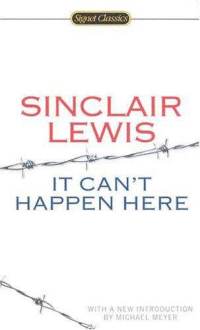
It Can't Happen Here


It Can't Happen Here by Sinclair Lewis
Adult Graphic Novels-Main Level GIA


The Great Depression was one of the defining events for the United States. In hindsight, it is easy for the current generation may just assume that our country was destined to pull through with our democratic system intact. But this was no guarantee. Powerful forces such as Father Coughlin, Huey Long, and the Business Plot against FDR were real, dangerous threats to American democracy. Authors such as Sinclair Lewis wrote works of fiction to criticize these authoritarian figures. Lewis’s 1935 novel It Can’t Happen Here is one of the many novels written last century that warns Americans about how fragile democracy can actually be. Many Americans have always assumed that a dictatorship is not possible in this country but Lewis details in chilling fashion how such a takeover could have happened at this vulnerable point in history.

Americans during this point of the Great Depression were weary and uncertain about the future. In the story, the charismatic Senator Buzz Windrip rises to power with his paramilitary group the Minute Men along with promises to restore American greatness. Windrip gains support by using xenophobia, prejudice, and even promises of paying Americans a cash sum after he is elected. These promises, along with the general discontent in the country, help him win the election of 1936. Windrip quickly consolidates power by curbing the authority of Congress, lets corporations extend their influence, and silences any dissent. While some characters can see the horrible direction these actions will lead the country, others dismiss these fears because they simply cannot believe a real dictatorship can happen in the country, hence the title of the book. The rest of the novel sees the main character Doremus Jessup enduring the tightening state control over his life while struggling to find a way to fight back.

Lewis’s novel may come from a different era but its lessons can apply to any generation. During any economic distress, citizens may turn to easy answers while people in power use the circumstances to justify their actions. This book will easily appeal to fans of the genres of dystopian fiction, political fiction, or alternate history.


Friday, October 19, 2012

Marcelo in the Real World


Marcelo in the Real World by Francisco X. Stork
Teen Zone Fiction - Main Level - Stork


Marcelo Sandoval is a seventeen year old boy. He is high-functioning on the autistic spectrum, similar to Asperger's Syndrome. He goes to a special school where they keep horses, and Marcelo plans to spend his summer working as Stable Boy. His father has other plans.

Marcelo's father, Arturo, wants Marcelo to spend the summer working in his law firm. He wants Marcelo to experience the "real world," away from other autistic kids and with other "normal" working adults. He also wants Marcelo to finish high school in the public school system. Marcelo feels comfortable at his special school, though, and the thought of attending public school puts fear into his heart. The deal is that if Marcelo successfully finishes a summer working at the law firm, Arturo will let him decide where he finishes high school.

This is a great story. Marcelo's thought process and the way he approaches problems is interesting and at times even funny. What an interesting look into the mind of a highly intelligent, unique, young man! Marcelo's understanding - and misunderstanding - of people and situations will keep you turning pages in this quick read. Highly recommended!

Monday, October 1, 2012

Giant Monster


Giant Monster by Steve Niles
Adult Paperbacks-Main Level LEWIS


As a kid, the idea of giant monsters or creatures of any type in horror movies was always good for entertainment. I was a massive fan of the Godzilla movies as a child and enjoyed both Cloverfield and the King Kong remake as an adult. While many of these movies seem cheesy today, giant monster movies such as ones from the 1950’swere used as a cautionary tale against mankind’s unchecked technological daring. Steve Niles of 30 Days of Night fame tries to replicate the spectacle of these giant monster horror movies with the graphic novel Giant Monster. The format of a graphic novel seems ideal for this type of story. Movies are limited by their special effects budgets while graphic novels are only held back by the imagination of an artist.

The storyline is light and easy to follow. Space shuttle pilot Don Maggert is infected with a space parasite which turns him into a massive brainless red monstrosity which grows larger as it devours everything in sight. Normal human military methods never work in these situations so of course the only real solution is to unleash a giant killer robot built by a former Nazi scientist. As you might have guessed by that last sentence, the plot takes several bizarre twists. This graphic novel is intended for mature audiences as several scenes of monster destruction and the aftermath can be gruesome in their depiction. The artwork manages to convey the proper scale for two giant creatures fighting although the colors are dark and dreary. Niles gets the spectacle right but Giant Monster is not for those who are looking for the social commentary of the previously mentioned monster works. The characters are nothing more than archetypes of the figures seen in other stories such as the men in black government figures, a couple of kids who get stuck in the mix, and a general who wants to shoot first and ask questions later. But with a title as simple as Giant Monster, readers should already not expect much in-depth storytelling. What they should expect is a carnage filled scare fest perfect for any horror fan.


Sunday, September 30, 2012

Battle of Blood and Ink

Battle of Blood and Ink by Jared Axelrod and Steve Walker.
Adult Graphic Novels – Main Level - BAT

The author’s note for this book says that the two guys were talking together about the craziest story they could come up with, and what they came up with was a floating city. The Floating City is a steampunky place, with distinct neighborhoods for different classes of people. Ashe, however, journalist and publisher of the insanely popular newspaper The Lurker’s Guide to the Floating City, goes wherever she wants. As the story opens, she has her friend and co-conspirator Tolban fly their little glider up close enough to catch the radio waves coming from a ship in distress. Not until the captain promises that he and his crew will go into slavery to the City are they allowed asylum. Once published, this secret is the one that finally determines the Provost of the City to stop the Lurker’s Guide. But Ashe is not without friends – she is not-so-secretly admired by Cardor, son of one of the richest citizens of the city. And for Ashe, being a target is only a reason to find more dark secrets to reveal and more ways to irritate those in power. The art is spare and angular black-and-white ink, which give it a modern feel despite the setting. The dark secrets were a little too dark to make this altogether light reading, and certainly make it most appropriate for adults or older teens, but this is a fun graphic adventure in a pseudo-Victorian, high-tech world.


Saturday, September 29, 2012

Where'd You Go, Bernadette


Where’d You Go, Bernadette by Maria Semple
Adult New Book Display – Main Level - SEMPLE

Simply put, I loved this book. I found myself laughing out loud while reading it and also being moved by the family relationships it explores. It is the story of a reclusive architect, Bernadette Fox, who lives in Seattle with her husband, Elgin, and 15 year old daughter, Bee. Bernadette is considered a genius in the architecture world, yet she hasn't designed anything in years. Instead, she spends her days getting into squabbles with other parents and neighbors and having a virtual assistant on the other side of the world take care of everything for her. She is also preparing for a family trip to Antarctica. However, right before the trip, Bernadette disappears. Bee tries to figure out what has happened to her mother and the novel is told through a series of emails, letters, notes, and other correspondence between characters, with commentary from Bee. Overall, Where'd You Go, Bernadette is an excellent and unique read.

Quiet


Quiet: the power of introverts in a world that can't stop talking
by Susan Cain
New Book Shelves - Upper Level - 155.232 C


I am an introvert. I would not say that I'm shy, exactly, but definitely introspective. I need a lot of alone time, and generally think before I speak. I feel most confident when I know my subject well, and prefer to write than speak. That said, I can deliver an engaging presentation to a room of 300 people (and have!), but running a meeting of 5 or 10 people is absolutely torturous.

This book is about how undervalued introverts are. We're seen as quiet, shy, and even non-participants by those who believe in what Cain calls "The Extrovert Ideal." As Cain's research reveals, though, introverts are responsible for some of the greatest innovations and inventions of our time, as well as masterpieces of art and music. We are team players and often excellent listeners - which lends itself to good leadership.

This book is for everyone, whether introvert or extrovert. It teaches us how to understand and appreciate each other; especially the particular intricacies of introverts.

Friday, September 21, 2012

Bitterblue

Bitterblue by Kristin Cashore
Teen Zone New Fiction – Main Level – Cashore

In Cashore’s first book, Graceling, our heroes defeated the sadistic King Leck, whose Grace allowed him to force people to hurt themselves or others and believe that nothing bad was happening. They rescued his ten-year-old daughter, Bitterblue, and set her on the throne with a team of advisors. Now Bitterblue is 18 and trying to repair the damage her father did to the kingdom. We’re talking kidnapping girls from every village in the kingdom just as a start, so this is no small matter. Her advisors are for the most part men who served her father, as well. They have decided that what the kingdom needs is forwardthinkingness, so that nothing from Leck’s reign will be discussed or brought up for trial. All crimes committed during the reign are forgiven, because Leck could have forced any crime. But Bitterblue feels that she needs to know what her father did and what’s going on with the kingdom now if she is to do her job. She starts sneaking out at night, finding the hidden pubs where people tell stories, often obliquely related to what happened during Leck’s reign. The very first night she is out, she befriends two young trouble-makers, Saf and Teddy, giving her name as Sparks to protect her anonymity. Thus her trying to find out the truth starts out with lies, which always complicate matters. Katsa and Po make brief visits from time to time, but they are busy trying to topple evil kings in other nearby kingdoms, and so cannot stay. The more Bitterblue learns, the more she realizes that the problems in the kingdom are deep. They did not die along with Leck, and she must find out who among her advisors she can trust and who is perpetuating the problems. Bitterblue journeys through darkness trying to understand her father, comparing remembering and forgetting as paths to healing. There’s a lot of dealing with ciphers, as Bitterblue’s mother taught her the theories of ciphers in secret, and both her parents used ciphers to keep their secrets. And while Bitterblue’s darkness is dark indeed, there’s still light to balance it, from the beauty of art and the joy of friendship, with a bit of early romance. It was very satisfying to see Bitterblue find her way towards a more open justice. It’s not for reading when one needs unicorns and rainbows (one does, sometimes), but it is a hopeful treatment of a dark subject.


Thursday, September 13, 2012

#DigitalVertigo


Digital Vertigo : how today's online social revolution is dividing, diminishing, and disorienting us by Andrew Keen
New Book Shelves - Upper Level - 302.231 K


Are you a member of a social network? If you're like me, you belong to several. Between Twitter, Facebook, Foursquare, LinkedIn, Groupon, and any number of other online communities, it is easier than ever to connect to other like-minded people. Sounds great, right?

@ajkeen (the author, Andrew Keen's Twitter handle) disagrees. In this book, he makes the argument that the more connected we are, the lonelier and less powerful we become. He acknowledges that the social media revolution is the most significant since the Industrial Revolution, but at a cost. It is so easy to voice our opinions and share our ideas and our whereabouts that we often alienate others. People may say things online that they wouldn't necessarily say out loud, which can offend or just plain annoy our online connections. Also, the more we share online, the less weight our words carry. Our points of view become just a part of the stream.

Keen also points out that as we join more networks and make more connections, we share more information about ourselves in more places. We want to participate in our networks and share with our "friends." Meanwhile, we complain about online security and privacy and want to keep our online information to ourselves. There's a catch-22 between wanting to share more and wanting that information to be private.

Finally, Keen says that we become lonelier as the very term "friend" becomes more and more shallow. Our networks, whether made up of "followers" or "friends" or some other term, are often surface connections. People collect connections, but do not often seek out relationships with those people. Why do we want to be so connected to people we care so little for?

This is a great book to make social networkers think about the information they share and who they share it with. We should re-evaluate our goals in using social networks. This book is a real eye-opener!

Friday, September 7, 2012

Oh No, George!


OH NO, GEORGE! by Chris Haughton
Youth New Book Shelves – Lower Level – HAU


When the owners are away, the dogs (or at least George) will play! When George’s owner Harry leaves for the day, George promises to be good. But, as George finds himself faced by a number of temptations, including cake on the kitchen table and a cat that is just begging to be chased, he realizes that being good is a lot harder than he ever expected.

With its retro illustrations and simple humor, Oh No, George! is sure to be a hit in any household. Children will love looking at the different comical expressions on George’s face and repeating the phrase 'Oh No, George!' with you as you read this book aloud. Released this year, Oh No, George! has all the right stuff to become a classic picture book.


Tuesday, September 4, 2012

Why Don't Penguins Feet Freeze?


Why Don't Penguins Feet Freeze? by New Scientist
Adult Non-Fiction-Upper Level 500 N


Life is filled with little questions that we sometimes do not even think about until they are spoken out loud. Why does skin become wrinkled after being in water? Why do birds not fall off their perches after falling asleep? What makes a boomerang come back to the thrower? And of course the age old question, why don’t penguins’ feet freeze? New Scientist magazine answers these types of questions and more in Why Don’t Penguins’ Feet Freeze which is a collection of questions written by the public to the magazine. Anyone who has had a random question such as these and cannot get to a librarian for answers would find much to enjoy in this book. The book is a quirky composite of scientific fact, trivia, humor, and also anecdotes from the experts in the various fields the questions come from and is sure to amuse all types of readers. Also pay attention to the penguin illustration on the far right of each page while flipping through the book to get a funny cartoon effect.

Saturday, September 1, 2012

Six Feet Under: The Complete First Season


Six Feet Under: The Complete First Season
DVD Collection-TV SIX


Six Feet Under is a show about saying goodbye. With rare exception, each episode begins with the death of a person whose body will pass through Fisher & Sons Funeral Home. The deaths range from devastatingly sad to darkly humorous and involve everything from interactions with machinery gone awry to visions of the Rapture. You see the Fisher family talk with the deceased person’s loved ones (or, in some cases, the person who is stuck tying up the loose ends for someone they only knew in passing…or for an ex-spouse). Sometimes, you even see the Fishers talk with the deceased themselves. Such interactions are similar to when Dexter Morgan interfaces with his dead father on Dexter. The words and actions of the deceased are dictated by whatever issue is currently vexing the living, making the visions less like hallucinations and more like projections.

Among those who are laid to rest by the Fisher family is patriarch Nathanial Fisher Sr. (Richard Jenkins, The Visitor), whose death kicks off the pilot episode when he is hit by a bus on Christmas Eve. He reappears throughout the series, interacting with wife Ruth (Frances Conroy, American Horror Story), adult sons Nate Jr. (Peter Krause, Parenthood) and David (Michael C. Hall, Dexter) and teenage daughter Claire (Lauren Ambrose, Can't Hardly Wait) in some of the show’s most poignant moments.

Part of what makes Six Feet Under so memorable is the complexity of its characters. You see each of the Fishers and their acquaintances in their best and worst moments. As a result, you’ll love and loathe each in turn. For better or for worse, you’ll also wonder about the interior lives of everyone you know or meet in real life.

When creator Alan Ball (American Beauty, True Blood) announced in 2005 that the show’s fifth season would be its last, I remember thinking, “surely this is a mistake.” There were still so many stories that could have been told and so many aspects of each character that could be explored. However, as anyone who has watched the show’s powerhouse finale knows, it wasn’t an error but rather the decision of someone who knew how to say goodbye with grace.